
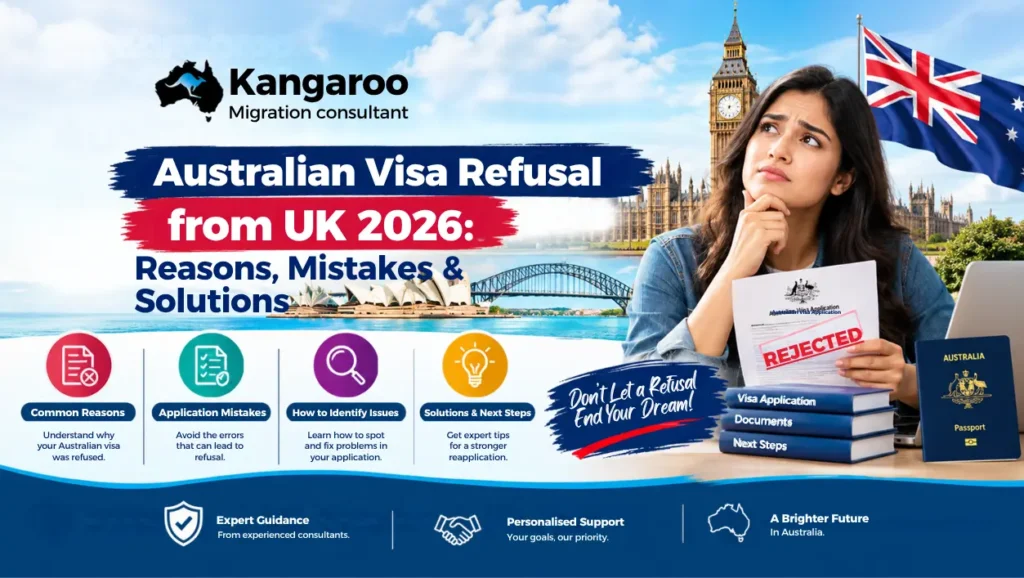
Quick answer: Receiving an Australian visa refusal from the UK doesn’t mean you can never apply again. The right next step depends on the visa subclass, the specific refusal reason, whether review rights exist, and whether the underlying problem can be fixed. The refusal notification is your starting point: read it carefully before deciding whether to seek review, reapply, or consider a different pathway.
There’s no single “Australian visa from UK” rule that explains every refusal. The reasons behind a refusal depend primarily on the visa subclass you applied for, your individual circumstances, and the evidence you submitted your UK residence can affect what evidence looks like, but it doesn’t change the underlying legal criteria.
Home Affairs has been clear that incomplete or non-decision-ready applications risk delay or refusal, and that every refusal notification explains the reasons for the decision and whether you have a right to seek review. This article walks through the most common categories of refusal, how UK residence fits into an Indian citizen’s application specifically, and what a sensible next step looks like. If you haven’t yet mapped out your broader options
Australian Visa Refusal from UK Living Change Anything?
Not in the way many applicants assume. If you’re an Indian citizen living in the UK, it’s worth keeping two things separate: your nationality and your UK residence status. A UK visa or residence permit doesn’t make you a UK citizen, and it doesn’t guarantee Australian visa approval your eligibility is still assessed against the specific Australian visa subclass you’ve applied for. What UK residence can do is shape your supporting evidence: UK employment, bank statements, tenancy records and immigration status can all be relevant depending on the visa, but simply lodging an application from the UK doesn’t improve your chances on its own.
Common Reasons Applications Are Refused
Rather than a ranked list Home Affairs doesn’t publish one it’s more accurate to think of refusal in terms of broad categories. Missing or incorrect documents are among the most preventable: expired evidence, unclear scans, or documents submitted in the wrong place can all undermine an otherwise solid application, and you shouldn’t assume you’ll always get a chance to fix a gap after lodgement.
Financial evidence is another frequent issue, particularly for visitor and student applicants unexplained large deposits, inconsistent income, or no clear source of funds can all raise questions, and there’s no single “correct” amount to show, since requirements depend entirely on the visa and your circumstances. For temporary visas, genuine temporary stay or genuine student concerns can arise where your travel plans, study rationale, or ties to your current circumstances don’t clearly support a temporary visit. UK employment, family and financial ties can serve as relevant evidence here, depending on the visa.
Information Accuracy and Character Issues
Inconsistent personal, employment or travel history across your application is treated differently from genuinely false information, and it’s worth understanding why. An honest mistake, a wrong date, a misremembered detail is assessed on its own facts, but deliberately false documents, hidden criminal history, undeclared family members or misrepresented employment carry much more serious consequences, potentially extending beyond the immediate refusal.
Character requirements generally call for relevant police certificates and an accurate declaration of any criminal history UK records may be relevant depending on your residence history and the visa, and character assessments can take considerable time to finalise. Health requirements follow a similar pattern: a medical examination or further testing doesn’t automatically mean refusal, but delays or unresolved health information can hold up a decision.
Visa-Specific Risk Areas
Different visa types carry different risk profiles. Visitor visa refusals often come back to weak evidence of genuine temporary intent or insufficient financial evidence. Student visa refusals frequently involve the Genuine Student requirement, course rationale, or financial capacity. Skilled visa refusals can stem from occupation eligibility, points calculation, skills assessment problems or insufficient supporting evidence.Employer-sponsored applications add another layer entirely, since a refusal can originate from the applicant, the employer’s nomination, or sponsorship issues independently.
Reading the Refusal Letter and Review Rights
The refusal notification is the single most important document after a refusal it should identify the visa subclass, the specific criterion or reason relied upon, and whether the decision can be reviewed by the Administrative Review Tribunal, along with the applicable deadline. Not every visa decision is reviewable, and the ART has been clear that it can review some, but not all, migration decisions the Department’s letter tells you which applies to your case.
It’s also worth knowing that recent legislative changes mean certain temporary visa refusal reviews, particularly student visa refusals, are now generally decided by the Tribunal without an oral hearing, based on written submissions alone, a shift intended to speed up a system that has faced significant backlogs. As for timing, ART processing data for migration reviews finalised in the six months to 31 March 2026 shows that half were finalised within roughly 1 year and 6 months of lodgement, a useful general guide, but not a promise for any individual case.
Reapply, Review, or Something Else?
Whether review or a fresh application makes more sense depends on what actually went wrong. If you believe the Department’s decision overlooked evidence you did provide, review may be worth pursuing where rights exist. If the problem was a genuine documentation gap, a new application with stronger evidence may be more appropriate. If your circumstances have materially changed since the refusal a new skills assessment, additional work experience, updated financial evidence that can also support a fresh application.
What doesn’t tend to work is resubmitting essentially the same application without addressing the stated reason, since that typically produces the same result. It’s also worth knowing that visa application charges are generally not refunded simply because an application was refused, so getting the next step right matters for more than just your timeline.
Does a Refusal Create Bigger Problems?
An ordinary refusal missing evidence, an eligibility gap is not the same as a character-related refusal or cancellation, and the two shouldn’t be treated as identical. Certain character-based decisions can trigger separate statutory consequences, including restrictions on future applications, while a straightforward evidence-based refusal generally doesn’t carry the same weight. A previous refusal generally needs to be disclosed accurately in future applications, and the effect it has depends heavily on why it occurred in the first place.
It’s worth getting specialist advice where character, false information, or a prior cancellation is involved, since these situations carry more complexity than a simple documentation issue. Seeking help from a registered migration agent or legal practitioner is particularly worth considering where the refusal reasoning is unclear, where an employer nomination was involved, or where you’re facing more than one previous refusal.
FAQs
What are the common reasons for an Australian visa refusal from the UK?
Common reasons can include incomplete or incorrect documents, insufficient financial evidence, concerns about genuine temporary stay or study intentions, inconsistent information, character issues, health concerns and visa-specific eligibility problems. The exact reason depends on the visa subclass and the applicant’s circumstances.
Does living in the UK affect an Australian visa application for Indian citizens?
Living in the UK does not automatically improve or reduce an Indian citizen’s eligibility for an Australian visa. However, UK employment, bank statements, tenancy records, immigration status and other evidence may help demonstrate the applicant’s circumstances when relevant to the visa being applied for.
Can I apply for an Australian visa again after a refusal from the UK?
Yes, a refusal does not automatically prevent you from submitting another application. Before reapplying, you should identify the specific refusal reason and address the underlying issue with stronger or updated evidence rather than simply submitting the same application again.
Can I appeal an Australian visa refusal from the UK?
Some Australian visa refusal decisions may be reviewable by the Administrative Review Tribunal (ART), while others are not. Your refusal notification should state whether you have review rights and provide the applicable deadline, so it should be checked carefully before deciding whether to seek review.
Should I reapply or seek a review after an Australian visa refusal?
The appropriate option depends on why the visa was refused, whether review rights are available and whether your circumstances or evidence have changed. A review may be relevant where there are grounds to challenge the decision, while a new application may be appropriate when the underlying issue can be corrected or circumstances have materially changed.
Final Thoughts and Your Next Step
Whether you’re trying to avoid a refusal before you lodge, or working through one you’ve already received, Kangaroo Migration Consultants can help you understand the specific reasons behind a decision, assess whether review or reapplication genuinely fits your circumstances, and prepare stronger evidence for your next step. Contact Kangaroo Migration Consultants today to get your Australian visa refusal or application properly reviewed.