
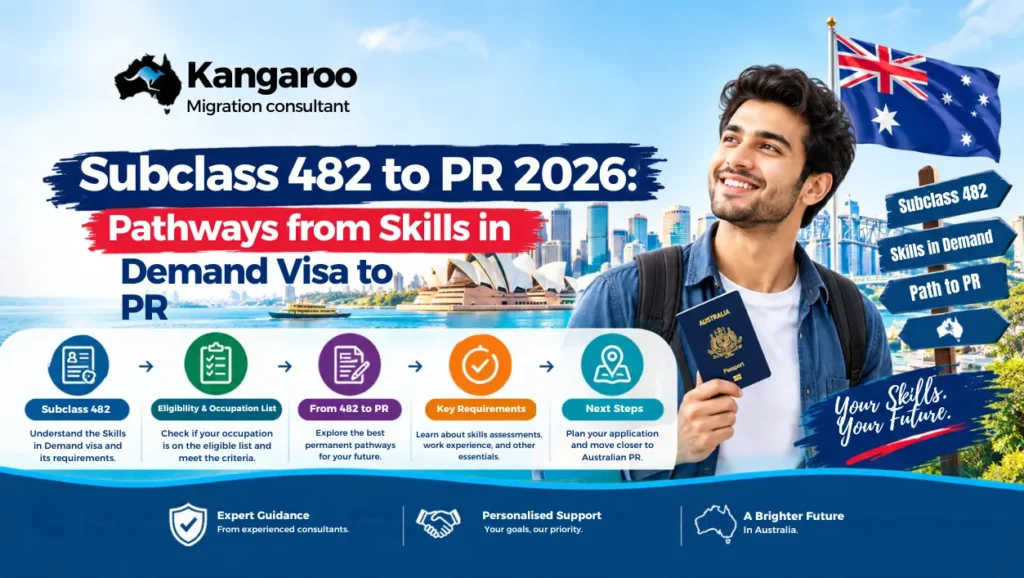
A Subclass 482 to PR transition is genuinely achievable for many Skills in Demand visa holders, but it requires a separate permanent visa application rather than any automatic conversion. At Kangaroo Migration Consultants, one of the first things we clarify with 482 holders exploring this is that eligibility depends on factors specific to each pathway sponsored employment history, occupation, age, English level and, for the employer-sponsored route, your employer’s continued willingness to nominate you. This guide focuses on the main pathway, the 186 Temporary Residence Transition stream, along with the independent and state-nominated alternatives available if employer sponsorship isn’t an option.
Is the Subclass 482 to PR Pathway, and Does Every Holder Qualify?
The 482 is a temporary visa, and it can lead toward permanent residence, but there’s no automatic transition you need to separately satisfy the requirements of whichever permanent visa you’re applying for. Not every 482 holder qualifies: eligibility depends on your visa stream, occupation, employer, length and nature of your sponsored employment, age, English result, salary, and your health, character and immigration history. The central pathway most 482 holders consider runs: 482 → employer nomination → Subclass 186 TRT → permanent residency, though independent and state-nominated routes remain available for those without ongoing employer sponsorship.
The 186 TRT Stream: The Main Route to PR
The Temporary Residence Transition stream is a permanent, employer-nominated visa designed specifically for people who’ve already been sponsored on a 457 or 482 visa, and it can be applied for either in or outside Australia depending on your circumstances. The process runs in sequence: you hold eligible 482 or 457 status, work in genuinely eligible sponsored employment, meet the TRT criteria, your employer nominates you, you lodge the 186 TRT application, and after health, character and other checks the visa is granted, giving you Australian PR from that point.
The 2-Year Work Requirement, and How It’s Actually Calculated
This is the single most-asked question, and getting the detail right matters. The TRT employment requirement was reduced from three years to two years on 25 November 2023, and it requires two years of full-time work in your nominated occupation, completed for an approved sponsor while holding a 457 or 482 visa, within the three years immediately before you apply.
Simply holding a 482 for two years isn’t enough on its own the employment itself must meet these specific rules, meaning part-time work generally doesn’t count, and a further refinement effective 29 November 2025 means only work actually performed for an approved sponsor counts toward the two years, so gaps, unpaid leave or non-qualifying periods can genuinely affect whether a clean two years still fits inside your most recent three-year window.
Where you’ve changed employers, work can still count from the date an approved nomination was lodged if you started working for that employer before the nomination was formally approved, but this needs checking carefully against your specific timeline rather than assumed.
Eligibility Beyond Employment: Age, English and Skills Assessment
Applicants generally need to be under 45 at the time of application, though limited exemptions exist for certain academics, researchers, regional medical practitioners and some high-income 457/482 holders if you’re approaching this threshold, the timing of your lodgement genuinely matters, so plan well ahead rather than leaving it until the last months. English requirements sit at Competent English for the TRT stream, and it’s worth knowing there’s currently no general exemption to this requirement, so don’t assume your existing 482 English evidence automatically satisfies the permanent visa’s standard without checking.
On skills, the TRT stream generally doesn’t require a formal skills assessment at the time of application, since your sponsored work history itself serves as evidence though the Department may still request one in individual cases to confirm your skills in the nominated occupation.
Salary Requirements and What Happens If Your Employer Won’t Sponsor You
Salary matters at the nomination stage: for nominations lodged between 1 July 2026 and 30 June 2027, the Core Skills Income Threshold sits at AUD 79,423, and this same threshold applies to ENS nominations during that period, alongside the Annual Market Salary Rate requirement that prevents a sponsor from underpaying relative to an equivalent Australian worker. The TRT stream specifically requires nomination by your current employer, so if that employer won’t sponsor you for PR, the honest answer is that you can’t force the issue through TRT your alternatives at that point are the independent Subclass 189, state-nominated Subclass 190, a regional pathway through 491 or 494, or a different employer willing to sponsor you through their own nomination.
Alternatives If You Don’t Have Ongoing Employer Sponsorship
482 holders aren’t limited to the employer-sponsored route. Subclass 189 offers a genuinely independent, points-tested pathway with no employer or state involvement required though holding a 482 provides no automatic priority or advantage in that process. Subclass 190 adds state or territory nomination on top of the same points-tested framework, while 491 offers a provisional regional route that can later transition to permanent residence once regional conditions are met. None of these should be treated as automatic alternatives, each has its own occupation, points, skills assessment and English requirements entirely separate from your 482 history.
What Happens If Your 482 Expires or Your Employment Changes
If your 482 is nearing expiry before your PR application is decided, your lawful status while waiting depends on your specific bridging visa and its conditions; this isn’t automatically identical for every applicant, so confirm your exact situation rather than assuming standard protection applies.
Changing employers before reaching your two-year TRT threshold is possible, but it resets the clock on what counts as eligible sponsored employment with your new employer, and losing your job altogether raises separate questions about maintaining lawful status and whether a new sponsor can be found within the time your current visa conditions allow. Each of these scenarios genuinely depends on individual timing and visa conditions, so getting advice before your situation becomes urgent rather than after gives you considerably more options.
Costs, Processing and Family Members
186 costs include the visa application charge (currently around AUD 6,000–6,200 for the base application from 1 July 2026, though this should be confirmed against the current official pricing before lodging), medical examinations, police certificates, and any migration agent fees, separate entirely from whatever your employer pays toward sponsorship and nomination our Australia PR cost breakdown covers these categories in more depth.
Processing for 186 applications now runs under Ministerial Direction 122’s own priority framework, entirely separate from your 482’s processing history. Working longer on your 482 doesn’t make 186 processing faster, since the two are assessed as genuinely independent applications. Eligible family members, including a partner and dependent children, can generally be included in your 186 application subject to their own health, character and, for adult dependents, English requirements.
FAQs
Can I apply for Australian PR after holding a Subclass 482 visa?
Yes. A Subclass 482 visa can provide a pathway to Australian permanent residence, but PR is not automatic. The main employer-sponsored pathway discussed in the article is the Subclass 186 Temporary Residence Transition (TRT) stream, provided you meet its eligibility requirements.
How long do I need to work on a 482 visa before applying for PR?
For the Subclass 186 TRT pathway, the article explains that applicants generally need two years of qualifying full-time work in their nominated occupation for an approved sponsor while holding a 457 or 482 visa, within the three years immediately before applying.
Can I get PR from a 482 visa if my employer will not sponsor me?
The 186 TRT pathway requires an employer nomination, so an employer who will not nominate you cannot be used for that pathway. Depending on your circumstances, alternatives may include Subclass 189, 190, 491 or 494, or sponsorship from another eligible employer.
Do I need to meet age and English requirements for 482 to PR?
Yes. For the Subclass 186 TRT pathway, applicants generally need to be under 45 when applying, subject to limited exemptions, and meet the Competent English requirement. Holding a 482 visa does not automatically mean you satisfy every requirement for the permanent visa.
Does holding a 482 visa guarantee Australian permanent residence?
No. A 482 visa is temporary and does not automatically convert into PR. You must separately satisfy the requirements of the permanent visa pathway you apply for, including requirements relating to employment, nomination, age, English, health, character and immigration history.
Final Thoughts and Your Next Step
Moving from a 482 to Australian PR is genuinely achievable through the 186 TRT stream for many sponsored workers, but success depends on correctly calculating your two-year qualifying employment, confirming your age and English position, and securing your employer’s continued nomination or, failing that, understanding which independent or state-nominated alternative genuinely fits your circumstances. If you’re a 482 holder wondering whether your employment history, occupation, age or employer situation supports a PR pathway, Kangaroo Migration Consultants can assess your circumstances and map out the realistic route forward and get in touch today before timing works against you.