
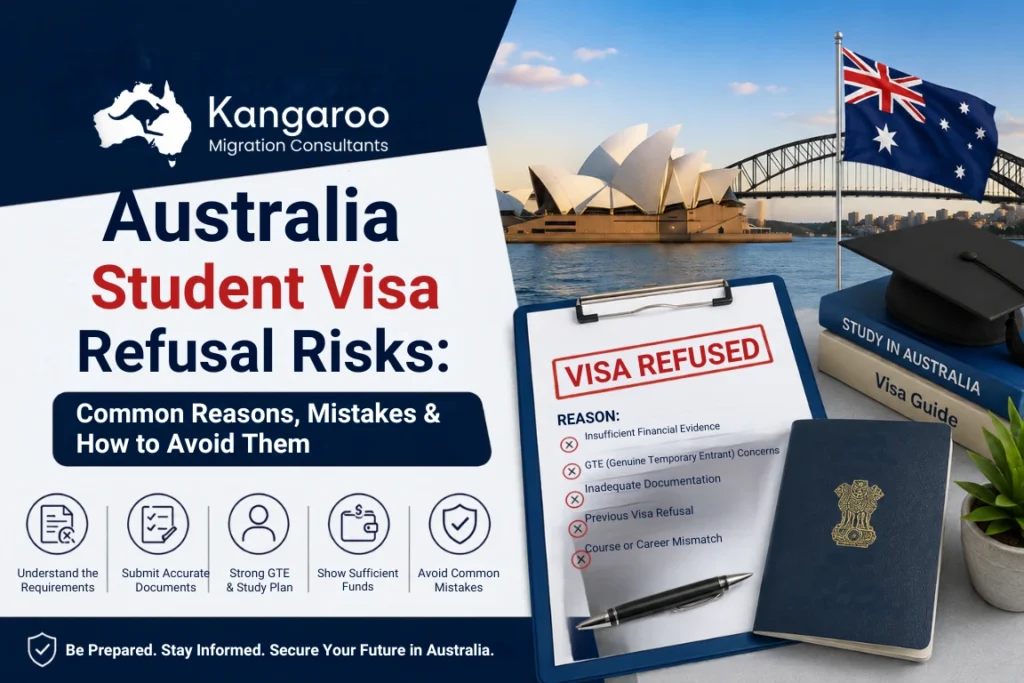
Applying for an Australian Student visa is a significant investment financially, academically, and emotionally and a refusal can disrupt study plans, finances, and future immigration options. Understanding Australia Student Visa Refusal Risks matters because refusal rarely comes down to one dramatic mistake. More often, it’s the cumulative effect of small inconsistencies across an application, a course choice that isn’t clearly explained, financial evidence that raises more questions than it answers, or a Genuine Student response that sounds generic rather than personal.
This guide covers the major risk areas: the Genuine Student requirement, financial capacity, course rationale, documents, English-language evidence, immigration history, health and character requirements, and application accuracy so you understand what genuinely affects an outcome versus what’s simply good practice.
What Is an Australia Student Visa Refusal?
A refusal means the Department of Home Affairs has decided, based on the applicable legislation and the evidence provided, that an applicant doesn’t meet the requirements for the visa. People commonly search for “refusal,” “rejection,” or a “declined application” these describe the same outcome rather than distinct legal concepts. After a refusal, the notification generally explains the reasons for the decision; whether review rights are available depends on the specific circumstances and decision type, so this shouldn’t be assumed either way without checking your own notification.
What Are the Main Australia Student Visa Refusal Risks?
| Refusal Risk | What Can Go Wrong |
| Genuine Student requirement | Study plans may not appear credible |
| Financial capacity | Evidence may not demonstrate sufficient funds |
| Inconsistent information | Application answers conflict with supporting documents |
| Weak course rationale | Course choice isn’t adequately explained |
| Missing documents | Required evidence isn’t provided |
| Incorrect documents | Documents don’t meet requirements |
| Previous immigration history | Past refusals or non-compliance may raise concerns |
| Health/character requirements | Relevant criteria aren’t satisfied |
| Misleading information | Can have serious consequences beyond a simple refusal |
| Failure to respond | Requested information isn’t provided in time |
Not every risk applies to every applicant — individual circumstances vary considerably.
The Genuine Student Requirement
Since 23 March 2024, Student visa applications have been assessed against the Genuine Student (GS) requirement, which asks applicants to show that studying in Australia is genuinely their primary reason for applying not simply a pathway to something else. The Department considers an applicant’s current circumstances, family and community ties, employment situation, previous study, the proposed course, why Australia and the specific provider were chosen, the benefits of the course, and future plans.
A GS response becomes weak when it’s generic or reads as copy-pasted, contradicts other parts of the application, poorly explains the course choice, shows no logical connection between prior study and the proposed course, makes unsupported career claims, or leans too heavily on migration outcomes rather than genuine study intent. A stronger response is personal, specific, evidence-backed, and logically consistent with the rest of the file it doesn’t need elaborate language, just clarity and honesty about your actual circumstances.
Financial Evidence and Refusal Risk
Financial capacity remains central to reducing Australia Student Visa Refusal Risks. Applicants generally need to demonstrate sufficient funds for their stay through bank statements, education loans, scholarship evidence, income evidence, or sponsor documentation. A weak financial profile isn’t always about having too little money, often it’s about unclear evidence: unexplained large deposits, inconsistent income figures, an unclear source of funds, or sponsor information that doesn’t logically add up. If parents or another sponsor are funding the trip, the relationship and their capacity to support you should be easy to follow from the documents provided. A genuine education loan can be relevant evidence when it meets the applicable requirements, but a high bank balance alone never guarantees approval; it’s one component among several.
Course Selection and Progression
Course choice isn’t just an admissions decision, it’s part of your visa credibility. Refusal risk increases when a course has no clear link to previous academics or work experience, when there’s a significant unexplained study gap, or when a chosen course sits at a noticeably lower level than a prior qualification without explanation. None of these automatically causes refusal, but each one needs a credible, honest explanation tying your background to your proposed study and future plans. Changing fields entirely is not inherently a problem provided the reasoning is genuine and well-supported.
Document Errors
Missing documents, incorrect details (wrong dates, names, expired documents), unclear scans, and inconsistencies between your passport, application, academic records, financial documents, and GS responses can all weaken an otherwise reasonable application. A current Confirmation of Enrolment (CoE) is essential since 1 January 2025, onshore applicants can no longer rely on a Letter of Offer in place of a CoE, so outdated advice on this point can create avoidable problems. Fake or fraudulent documents deserve the strongest possible warning: providing false or misleading information carries consequences well beyond a standard refusal and can affect future applications indefinitely.
English Language Requirements
English requirements can depend on individual circumstances and exemptions, so it’s worth checking current rules rather than relying on older sources. The minimum English score for Student visa applicants was raised from IELTS 5.5 to 6.0 (or the equivalent in another accepted test) in 2024, and the list of accepted English tests for Australian visa purposes was updated again on 7 August 2025. Beyond simply meeting the score, your test evidence needs to come from a currently accepted test and remain within its validity period; outdated test evidence is a common, avoidable mistake.
Previous Visa Refusals and Immigration History
A previous refusal whether from Australia or another country should always be disclosed accurately where required; never attempt to conceal one. Immigration history is a relevant context, and the right approach is to understand what led to the previous refusal, address it honestly, and provide evidence showing what has genuinely changed since. A prior refusal doesn’t automatically prevent future approval, but pretending it didn’t happen is far riskier than addressing it directly.
Health, Character, and Application Accuracy
Health examinations may be required depending on individual circumstances, and character requirements including honest disclosure of any relevant criminal history apply to all applicants. Providing inaccurate character information creates problems well beyond the underlying issue itself. More broadly, application accuracy matters throughout: incorrect personal, education, or employment details, missing travel history, contradictions between your application and your documents, and failing to respond to Department requests within deadlines are all avoidable risks.
Work-Focused Applications
A Student visa is fundamentally a study visa. Visa holders are generally subject to a work limit of 48 hours per fortnight during term time, unless an exception applies. If your course choice, GS statement, and financial story collectively suggest that work opportunities matter more than genuine study intent, the application can start to look less credible particularly if the course itself already appears weakly justified. Keeping the application study-led, with a clear academic and career rationale, is the safest approach.
Interviews and Processing
Not every applicant is contacted for an interview, but if you are, expect questions about your course and provider choice, previous studies, career plans, financial arrangements, and future intentions. The most common interview mistakes are memorized or scripted answers, contradictions with the written application, and vague or generic responses. The best preparation is genuinely knowing your own application rather than rehearsing a script.
Separately, processing priority (currently guided by Ministerial Direction 115 for offshore Australia Subclass 500 applications lodged on or after 14 November 2025) affects the order and speed of processing based on the education provider; it does not affect whether an application is approved or refused.
Reducing Your Refusal Risk
The most effective approach is to lodge a complete, decision-ready application: check current requirements before applying, understand the Genuine Student requirement thoroughly, choose a course that logically fits your background, prepare transparent financial evidence, keep all information consistent, explain any study gaps honestly, disclose immigration history accurately, prepare health and character information, check every document before submission, keep copies of everything, and respond promptly to any Department requests. Where your circumstances are complex previous refusals, unusual course changes, or complicated financial arrangements, professional guidance can help you identify issues before you lodge, not after.
What Happens If Your Visa Is Refused?
If refused, read the notification carefully, identify the specific concerns raised, and check whether review rights apply to your situation. Simply resubmitting the same application without addressing the underlying reasons rarely solves the problem; a stronger reapplication means correcting errors, strengthening weak evidence, and directly addressing whatever concerns led to the refusal in the first place. A previous refusal doesn’t permanently prevent approval, but it does require the next application to be genuinely different, not just resubmitted.
Final Thoughts
Reducing Australia Student Visa Refusal Risks isn’t about finding one magic document or hitting a specific bank balance it comes down to presenting a genuine, accurate, and internally consistent application across five key areas: the Genuine Student requirement, financial capacity, course and study rationale, accurate documentation, and complete, truthful information throughout. No legitimate migration professional can guarantee a visa outcome, but careful preparation meaningfully reduces avoidable risk.
FAQs
What are the most common Australia Student Visa Refusal Risks?
The most common Australia Student Visa Refusal Risks include weak Genuine Student responses, unclear or insufficient financial evidence, poor course progression, missing or inconsistent documents, and inadequate English test evidence.
Does a study gap automatically increase Australia Student Visa Refusal Risks?
No, a study gap alone doesn’t automatically increase Australia Student Visa Refusal Risks what matters is providing a clear, honest explanation supported by evidence, such as employment or other legitimate activities during that period.
Can weak Genuine Student answers increase Australia Student Visa Refusal Risks?
Yes. Generic, copy-pasted, or vague GS responses are one of the biggest Australia Student Visa Refusal Risks, since the Department expects specific, personal answers that logically connect your background to your proposed course.
Can a previous visa refusal affect future Australia Student Visa Refusal Risks?
A previous refusal is relevant context and should always be disclosed accurately, but it doesn’t automatically increase Australia Student Visa Refusal Risks for a new application what matters is honestly addressing what led to the earlier refusal and showing what has changed.
How can applicants reduce Australia Student Visa Refusal Risks before lodging?
The best way to reduce Australia Student Visa Refusal Risks is to lodge a complete, decision-ready application a logical course choice, strong GS responses, transparent finances, valid English evidence, a current CoE, and consistent information throughout.
Concerned about Australia Student Visa Refusal Risks? Before submitting your application, have your course selection, Genuine Student responses, financial evidence, and supporting documents reviewed carefully. Kangaroo Migration Consultants can help you understand the current application requirements and identify potential issues before you lodge read more study visa guidance on our blog or speak with our team about your Australian study plans today.