
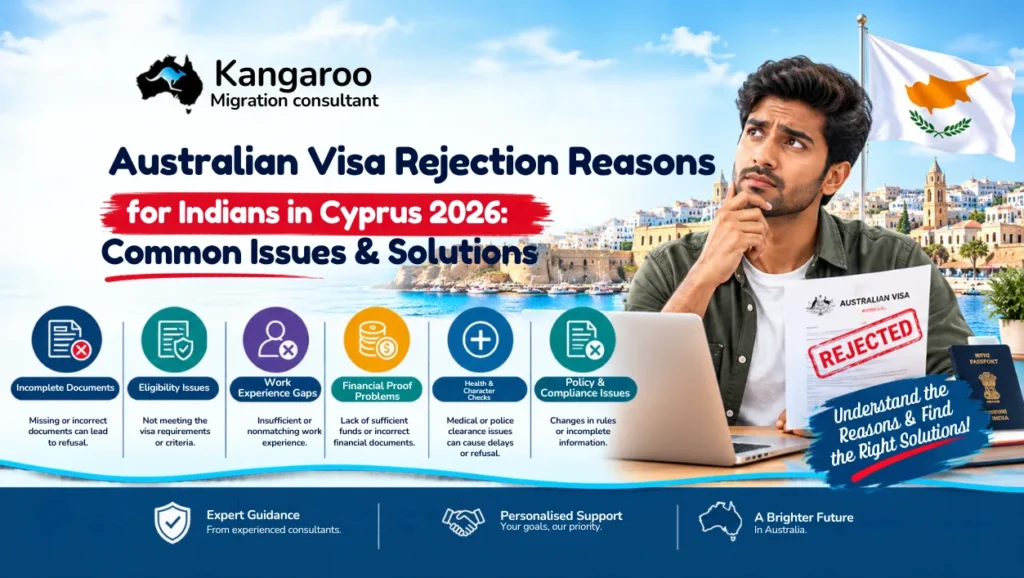
A refusal can derail travel, study, work or migration plans overnight, which is why understanding the Australian visa rejection reasons for Indians in Cyprus before you lodge, or after a refusal arrives, is so valuable. At Kangaroo Migration Consultants, the first thing we explain to Indian passport holders based in Cyprus is that there is no single refusal reason covering every visa: an application is refused when the Department of Home Affairs isn’t satisfied that the criteria for that specific subclass are met, usually because evidence is missing, inconsistent or doesn’t support the claims made.
Living in Cyprus doesn’t automatically raise or lower your chances either, since you’re assessed as an Indian citizen against the requirements of the visa you chose, with Cyprus residence acting as supporting evidence of your circumstances. If you’re still deciding which pathway fits, our overview of Australian visa eligibility requirements is a useful starting point.
The Main Categories of Rejection Risk
Most refusals fall into a handful of recurring categories: insufficient evidence of your purpose of travel or intended stay, inadequate financial evidence where it’s required, missing or inconsistent documents, failing to meet a visa’s core eligibility criteria, health or character concerns, and incorrect answers or undisclosed information. Skilled and employer-sponsored visas add occupation, skills assessment, sponsorship, nomination and English requirements on top. Because the criteria differ so much between a visitor visa, a student visa and a skilled visa, the same weakness, such as thin financial evidence, can be decisive in one category and barely relevant in another, so always check the requirements for your exact subclass rather than relying on generic advice.
Visitor Visa Rejection (Subclass 600)
For visitors, the recurring problem is weak evidence of a genuine, temporary visit. That can mean an unclear purpose of travel, an itinerary that doesn’t match the length of stay, or little to show why you’ll return to your life in Cyprus, such as employment, family or study commitments. Financial evidence is the second big issue: statements that don’t clearly show your position, large recent deposits with no explanation, unclear third-party funding, or a budget that doesn’t fit the planned trip can all raise doubts.
The practical fix is to explain your trip clearly, provide recent statements, payslips and tax or business records, explain any significant deposit, and, where someone else is funding the visit, document the relationship and their capacity to pay. An invitation letter helps establish purpose but never replaces the rest of the evidence, and undeclared previous refusals or unexplained gaps in your travel history create further problems. Careful preparation against the current tourist visa requirements removes most of these avoidable weaknesses before you lodge.
Student and Skilled Visa Rejection
Student visa refusals most often centre on the Genuine Student requirement, where the course choice doesn’t connect convincingly with your previous study or work, your study plans are poorly explained, or financial evidence doesn’t show the source and genuine accessibility of the funds. Missing academic records, inconsistent identity details or absent English evidence add to the risk.
For skilled visas, the problems are different: an unsuitable or expired skills assessment, duties that don’t match the nominated occupation, points that can’t be substantiated, or a misunderstanding of how an Expression of Interest differs from a visa application. Where a state or territory is involved, failing to meet Australian state nomination criteria is another common trap, since federal eligibility doesn’t automatically satisfy a specific jurisdiction.
Employer-Sponsored Visa Rejection
Employer-sponsored applications can fail on either side of the relationship: the employer’s sponsorship or nomination may not meet requirements, the nominated position may not be eligible, or required stages may be incomplete. On the applicant’s side, insufficient or poorly evidenced work experience, qualifications that don’t support the role, or salary requirements not being met are frequent causes, as are employment duties that differ from the nominated occupation. Keeping contracts, reference letters and payslips consistent, and confirming the position and pathway before lodgement, reduces these risks considerably; the current employer-sponsored visa options vary by subclass and stream, so requirements should be checked for the exact visa involved.
Incorrect Documents, False Information and Financial Problems
Across every category, documentation errors do a surprising amount of damage: mismatched name spellings, dates that differ between documents, missing pages, expired records, inadequate translations and undisclosed previous refusals. There’s an important difference between an honest clerical error and knowingly providing false or misleading information, which can lead to refusal, visa cancellation and restrictions on future applications, so never alter, fabricate or conceal a document. There’s also no universal bank balance that guarantees approval for every visa; what matters is that your financial evidence fits your visa type, trip or study plan, and is consistent and explainable across the whole application.
Cyprus-Specific Considerations
A Cyprus residence permit establishes your immigration status in Cyprus, but it doesn’t satisfy Australian visa criteria or earn preferential treatment. What it can do is support your evidence: keep your Indian passport, valid residence permit, employment contract and employer letter, payslips, tax records, bank statements, accommodation evidence and travel history organised and consistent. If you’re only in Cyprus temporarily, for study or short-term work, document that accurately, and remember that any document not in English generally needs an English translation that matches the original. Health and character requirements also apply, so answer every question truthfully, attend any requested medical examination, and provide police certificates when asked.
What to Do After a Rejection
Start by reading the refusal letter carefully to identify the visa subclass, decision date, the criteria you were found not to meet, and any review information or deadlines. Then separate the main refusal reasons from background detail and decide whether the problem is missing evidence, an eligibility gap or an inconsistency. Review rights aren’t universal: the Administrative Review Tribunal reviews certain migration decisions, but whether yours qualifies depends on the decision type and the wording of your notice, so check that immediately, because deadlines can be strict. Understanding your Australian visa refusal review rights properly before choosing between review and a new application matters, because reapplying without fixing the original problem rarely changes the outcome.
Reapplying and Preventing a Second Rejection
A new application may be possible, but it should directly address every material refusal reason, correct errors, update expired documents and confirm you still meet the criteria. Sometimes a different subclass genuinely suits your purpose better, but switching categories just to try again isn’t a strategy. Any previous refusal must be declared accurately on future applications, and the facts of the earlier decision, rather than the refusal alone, shape how it’s viewed.Before lodging anything, confirm the subclass matches your purpose, check names and dates against your passport, verify your financial evidence and source of funds, confirm translations, and review every attachment.
FAQs
What are the common Australian visa rejection reasons for Indians in Cyprus?
Common reasons include insufficient evidence of the purpose of travel, inadequate financial evidence, missing or inconsistent documents, failure to meet visa eligibility criteria, health or character concerns, and incorrect or undisclosed information. The exact reason depends on the visa subclass and the applicant’s individual circumstances.
Can weak financial evidence lead to an Australian visa rejection for Indians in Cyprus?
Yes. Financial evidence that does not clearly support the planned trip, study or stay can contribute to a refusal. Large unexplained deposits, unclear sources of funds or financial records that do not match the proposed plans can raise concerns.
Does living in Cyprus affect an Australian visa application for Indian citizens?
Living in Cyprus does not automatically increase or reduce eligibility for an Australian visa. However, Cyprus residence documents, employment records, financial evidence and travel history can help demonstrate the applicant’s circumstances when they are relevant to the particular visa.
What should I do after an Australian visa rejection from Cyprus?
First, carefully review the Department of Home Affairs refusal letter to identify the specific visa criteria that were not met. Then determine whether the issue involves missing evidence, an eligibility problem or inconsistent information, and check whether review rights or a new application may be available.
Can I reapply for an Australian visa after a refusal in Cyprus?
Yes, a new application may be possible depending on the circumstances. Before reapplying, applicants should address the material refusal reasons, correct any errors, update supporting documents and accurately declare the previous refusal in the new application.
Final Thoughts and Your Next Step
Australian visa refusal reasons differ by subclass and individual circumstances, and Indian applicants in Cyprus are best served by documenting their situation accurately and following the criteria for their intended visa. If your Australian visa application has been refused, Kangaroo Migration Consultants can help you understand the issues identified in the decision, explore the available next steps, and prepare for a stronger application, though no visa outcome can be guaranteed. Contact us today to discuss your circumstances.