
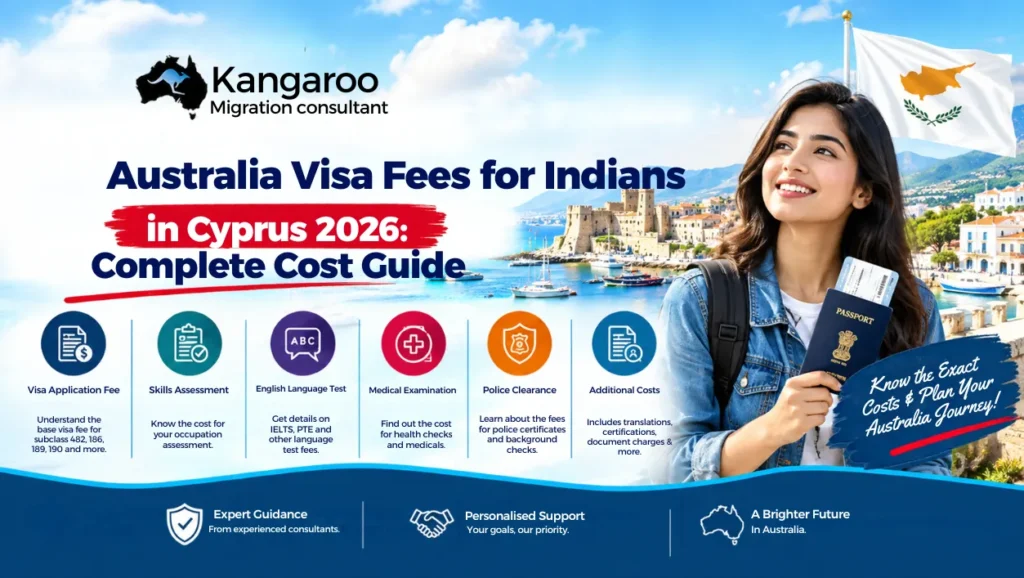
If you’re an Indian citizen living in Cyprus and planning an Australian visa, the first thing to know is that there’s no single fees that applies to everyone. The cost depends mainly on the visa subclass, how many people are on the application, and when and how you lodge, not on the fact that you live in Cyprus. On top of the government charge, most applicants also need to budget for medical examinations, police certificates, English tests, skills assessments, translations and, if used, professional assistance.
Australian visa Fees rose by roughly 25% for many categories from 1 July 2026, so older figures found online are often out of date. Kangaroo Migration Consultants can help Indians in Cyprus identify the right visa pathway and estimate the full application budget before lodging, and our overview of Australia migration eligibility is a useful place to check whether a pathway fits your profile first.
Does Living in Cyprus Change the Visa Fees ?
Not in itself. Home Affairs calculates the visa application fees using factors such as the visa subclass, the date the application is received, whether you apply online, whether you are inside or outside Australia when applying, and how many adults and children are included. Cyprus residence doesn’t create a “Cyprus surcharge,” and Indian nationality doesn’t automatically change the base charge either. What can differ is your local cost of supporting requirements for example, medical appointments, translations and police certificates in Cyprus or India which are separate from the government fees. If you’re exploring which route suits an Indian living abroad, our guide to Australia PR pathways explains how the main options differ before cost even enters the picture.
Base Visa Charges From 1 July 2026
Reported figures for the primary applicant from 1 July 2026 include: Visitor visa (subclass 600, offshore tourist) around AUD 250; Student visa (subclass 500) AUD 2,500 for most applicants, with a lower AUD 2,050 tier for ELICOS and non-award courses; Skills in Demand visa (subclass 482) AUD 4,015; Skilled Independent (subclass 189) AUD 6,135; and Skilled Nominated (190), Skilled Work Regional (491), Employer Nomination Scheme (186) and Skilled Employer Sponsored Regional (494) around AUD 6,140.
These are base charges only, and secondary sources don’t always agree on every line, so treat them as a planning guide and confirm the exact amount on the official Home Affairs Visa Pricing Estimator immediately before you pay. The charge that applies is generally the one in force on the date your application is received, so a price change between preparing and lodging can leave you paying the higher amount.
Visitor and Student Visa Fees
A visitor visa from Cyprus usually involves the lowest government charge, though a medical or biometrics request can add cost in some cases. Students need to look beyond the AUD 2,500 base charge: Overseas Student Health Cover, English test fees, medicals and tuition are all separate expenses, and the visa fee should never be confused with tuition. the Australia Student Visa covers the wider requirements, including English evidence and the Genuine Student assessment, which affect how much preparation you’ll need to pay for.
Skilled Visa Costs: 189, 190 and 491
For points-tested skilled migration, the visa charge is only one line in the budget. You’ll usually also need a skills assessment from the authority for your occupation, an accepted English test, health examinations and police certificates. Subclass 189 needs no state nomination, while 190 and 491 depend on state or territory nomination, and any nomination-related cost varies by state, so don’t assume every jurisdiction charges the same.
If you’re weighing the state-nominated routes, our overview of Australian state nomination explains how nomination works and why requirements differ from one state to the next. Skilled applicants from Cyprus should also remember that an Expression of Interest itself is not a visa application and isn’t charged as one the visa charge is payable only once you’ve been invited and lodged.
Employer-Sponsored Costs: 482, 186 and 494
Employer-sponsored visas split costs between the worker and the sponsoring business. The applicant generally pays their own visa application charge plus personal supporting costs such as medicals, police certificates and any English or skills documentation, while the employer carries sponsorship and nomination-related costs, which are treated differently from personal visa expenses. Employers nominating for 482, 494 and 186 must also meet salary requirements: for nominations lodged from 1 July 2026, the Core Skills Income Threshold and TSMIT are AUD 79,423 and the Specialist Skills Income Threshold is AUD 146,576. If you’re considering this route from Cyprus.
Family Members, Surcharges and Second Instalments
Every family member included in an application generally adds an additional applicant charge, and Home Affairs prices these separately for people aged 18 or over and under 18. A couple or family of three or four can therefore cost far more than a single-applicant budget suggests, and family members typically need their own medicals and, for adults, police certificates. Some visas also have a second instalment payable before grant, which the online estimator may not fully capture.
Payment can add further cost: a surcharge may apply if you pay visa application, sponsorship or nomination fees by credit card or PayPal, and your Cypriot or Indian bank may add foreign-transaction charges when converting from euros or rupees into Australian dollars. Check your card limits and international payment settings before you attempt to pay, since a failed or short payment can hold up an application.
Converting AUD Into EUR and INR
Australian government charges are stated in Australian dollars, so any euro or rupee figure is only an estimate that moves with exchange rates. To budget, multiply the AUD amount by the current AUD/EUR or AUD/INR rate, then allow a buffer for your bank’s margin and any card fees, rather than relying on a fixed conversion published months earlier. It’s also worth remembering that fees are generally not refunded simply because an application is refused or withdrawn, so getting your eligibility and documents right first is part of managing cost, not just a formality.
Building Your Total Budget
A realistic estimate adds up the visa application charge, additional applicant charges, any second instalment, skills assessment and English test costs where relevant, medicals, police certificates for each country you’ve lived in, translations and certifications, any state nomination cost, a payment surcharge, and optional professional fees. The exact mix depends on your pathway: a visitor visa from Cyprus may involve little beyond the base charge, while a family skilled application can involve many separate line items. Keeping a small contingency is sensible, since Home Affairs can request further health checks or documents after you lodge.
FAQs
How much does an Australian visa cost for Indians in Cyprus in 2026?
The Australian visa fee depends on the visa subclass, application circumstances and number of applicants. From 1 July 2026, example base charges include around AUD 250 for an offshore Visitor visa, AUD 2,500 for most Student visa applicants, AUD 6,135 for subclass 189, and around AUD 6,140 for subclasses 190, 491, 186 and 494.
Does living in Cyprus change the Australian visa fee for Indian citizens?
No. Living in Cyprus does not create a separate Australian visa fee or “Cyprus surcharge.” The applicable government charge is generally determined by the visa subclass and application circumstances, while costs for medicals, police certificates and translations can vary depending on where you live.
What additional costs should Indians in Cyprus budget for an Australian visa?
In addition to the government visa application charge, applicants may need to pay for medical examinations, police certificates, English language tests, skills assessments, document translations and certifications. State nomination fees or professional migration assistance may also apply depending on the visa pathway.
Are Australian visa fees refundable if my application is refused?
Australian visa application charges are generally not refunded simply because an application is refused or withdrawn. Applicants should therefore confirm their eligibility and prepare the required documentation carefully before lodging and paying the visa application charge.
Do Australian visa fees increase for family members?
Yes. Including a spouse, partner or dependent children can increase the total application cost because additional applicant charges may apply. Family members may also have separate costs for medical examinations, police certificates, translations and other supporting requirements.
Get Your Australian Visa Costs Planned From Cyprus
Working out the right visa subclass and a realistic total budget is far easier with a proper profile review than with fee tables alone. Kangaroo Migration Consultants can assess your eligibility, help you choose between visitor, student, skilled or employer-sponsored options, prepare your documents, and map out the costs for you and your family before you lodge. Contact Kangaroo Migration Consultants today to plan your Australian visa application from Cyprus with confidence.