
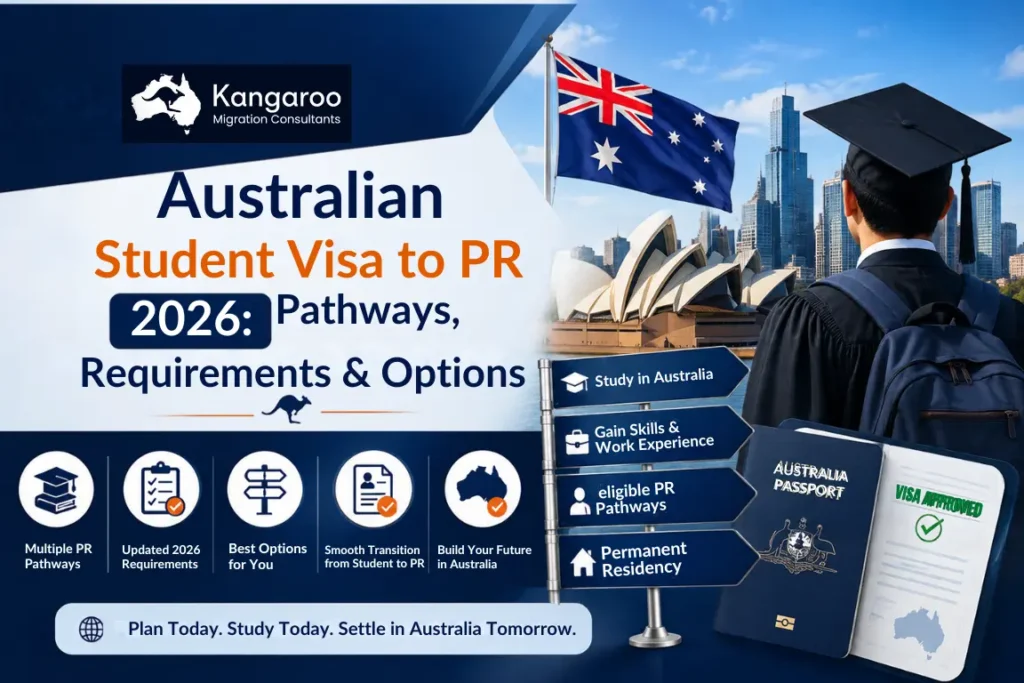
Every year, thousands of international students arrive in Australia with the same long-term hope: to study, gain experience, and eventually call the country home. But here’s the reality worth understanding early: an Australian Student Visa to PR journey is not automatic. Studying in Australia does not, on its own, guarantee permanent residency. Instead, international students may build a pathway toward PR through education, skilled employment, state or territory nomination, regional migration, or employer sponsorship, depending on their individual circumstances and the migration settings in force at the time.
A common (simplified) journey looks like this: Student Visa → Graduation → Post-study/work option → Skills/occupation development → Skilled or employer-sponsored pathway → Permanent Residency. But not every student follows this exact sequence, and the specific pathway depends on factors like age, qualification, occupation, skills assessment outcome, English ability, work experience, points, state nomination, and current migration policy. Australia Skilled visa pathways (subclasses 189, 190, and 491) work through the Department’s Skill Select system, where eligible candidates submit an Expression of Interest (EOI) and wait to be invited; invitation isn’t guaranteed simply by meeting minimum criteria.
Can You Get Australian PR After a Student Visa?
No, an Australian Student visa (Subclass 500) does not automatically lead to PR. It’s important to distinguish between a temporary Student visa, temporary graduate/work visas, provisional skilled visas, and permanent visas; each sits at a different stage of a much longer process. Australian study can genuinely help develop your eligibility for certain migration pathways through qualifications, skills assessment eligibility, and sometimes additional points but study itself is not a PR visa. Whether a student can eventually secure PR depends on their occupation, age, English ability, qualifications, skills assessment outcome, work experience, points score, and whether they meet state/territory or regional criteria. PR is never guaranteed simply by completing a course in Australia.
The Student Visa to PR Pathway, Step by Step
- Choose a suitable course
- Study in Australia
- Graduate
- Gain eligible post-study/work experience where applicable
- Obtain a skills assessment if required
- Build your English, points, and employment profile
- Submit an EOI or pursue an employer/state pathway
- Receive an invitation, nomination, or sponsorship where required
- Apply for the relevant visa
- Become a permanent resident, if the visa is granted
Different applicants enter and exit this sequence differently; some skip the Temporary Graduate stage entirely, while others spend years building toward eligibility.
Main Pathways in 2026
| Pathway | Type | Main Concept |
| Subclass 189 | Permanent | Skilled Independent |
| Subclass 190 | Permanent | State/Territory Nominated |
| Subclass 491 → 191 | Provisional → Permanent | Regional pathway |
| Employer sponsorship → 186 | Permanent | Employer-Sponsored (Employer Nomination Scheme) |
| 482 → 186 | Temporary → Permanent | Employer-sponsored pathway |
The Department of Home Affairs currently lists subclasses 189 and 190 among its permanent skilled visas, with subclass 191 as a permanent regional visa.
Skilled Independent Visa (Subclass 189)
The Skilled Independent visa allows invited skilled workers to live and work in Australia permanently, without needing state nomination or an employer. Eligibility depends on having an occupation on the relevant skilled list, a positive skills assessment, adequate English, sufficient points, and meeting the age requirement then waiting for an invitation through SkillSelect. Australian study can contribute toward your points profile, but it doesn’t guarantee an invitation on its own; competition for 189 invitations can be intense, since it’s entirely points-ranked with no state involvement. It’s not necessarily suitable for every international student, much depends on your specific occupation and points score.
Skilled Nominated Visa (Subclass 190)
Subclass 190 is a permanent visa for skilled workers nominated by a state or territory. Each state and territory sets its own nomination criteria, which can change between program years, so eligibility depends heavily on current settings rather than a fixed rule. Studying in a particular state does not guarantee nomination there; NSW, Victoria, Queensland, South Australia, Western Australia, Tasmania, the ACT, and the Northern Territory each run their own programs, and none can be described as permanently “best,” since settings shift regularly.
Regional Pathway: Subclass 491 to Subclass 191
Subclass 491 is a provisional Skilled Work Regional visa; after meeting its conditions, eligible holders can progress to Subclass 191, a permanent regional visa. Based on current published requirements, applicants for 191 must have held an eligible provisional visa (491 or 494) for at least three years, provide ATO Notices of Assessment for three income years during that period, and have complied with the conditions of their provisional visa including living, working, and studying within a designated regional area. There’s currently no points test and no employer sponsorship required for the 191 stage itself. “Regional Australia” has a specific migration definition that excludes major metro centres like Sydney, Melbourne, and Brisbane and always checks the current designated regional area list rather than assuming a location qualifies. Regional study doesn’t guarantee PR, but it can open pathways not otherwise available.
Employer-Sponsored Pathway
An Australian employer can sponsor an eligible graduate for a permanent visa such as Subclass 186 (Employer Nomination Scheme), which requires employer nomination alongside the applicant meeting relevant occupation, skills, and experience requirements. A Temporary Graduate (Subclass 485) visa holder may eventually move toward employer-sponsored PR, but this depends entirely on the visa pathway, occupation, employer, and applicable requirements at the time it’s not automatic. Employer-sponsored pathways differ from points-tested migration in a key way: they depend on employer eligibility and nomination rather than a competitive points score, though occupation, salary, and experience still matter.
The Temporary Graduate Visa (Subclass 485)
The Subclass 485 visa offers eligible graduates a period of post-study work rights; it is not a PR visa itself. Its real value lies in the time it can provide to gain relevant work experience, pursue a skills assessment, build a stronger migration profile, and potentially secure employer sponsorship. Not every graduate is eligible, and settings around this visa have changed before, so it’s worth checking current requirements rather than planning around assumptions from a few years ago. The 485 isn’t universally mandatory either; some graduates move directly into a skilled or employer-sponsored pathway if they already meet the relevant requirements.
Points, Requirements, and Course Choice
For points-tested visas, factors typically include age, English proficiency, skilled employment experience, qualifications, and sometimes partner or regional study factors. 65 points is the minimum threshold for certain points-tested skilled visas but meeting the minimum doesn’t guarantee an invitation, since invitations are issued in ranked rounds and competition for popular occupations can push effective scores well above the minimum.There’s no such thing as a single “PR course” that guarantees permanent residency; a smarter approach is choosing a course connected to a genuinely in-demand occupation, verified through the Australian Government’s Skilled Occupation List, rather than a course simply because it’s popular or “trending.” Fields like healthcare and nursing, teaching, engineering, IT, construction and trades, and accounting often carry stronger occupation demand, but none of them guarantee an outcome, occupation lists and state priorities change, sometimes significantly, between program years.
A master’s degree doesn’t automatically translate into more PR points than a bachelor’s. What matters more is whether your qualification connects to an eligible, in-demand occupation with a matching skills assessment, alongside your age, English, and work experience.
Common Mistakes That Hurt a Student-to-PR Plan
Some of the most damaging (and avoidable) mistakes include choosing a course purely because someone claims it “leads to PR,” ignoring occupation-list eligibility entirely, assuming the 65-point minimum guarantees an invitation, waiting until final semester to research migration options, neglecting English improvement, not building relevant work experience, ignoring state nomination criteria, assuming regional study automatically secures nomination, and relying on outdated migration information state and territory nomination allocations, in particular, are published and revised for each program year, so last year’s advice may no longer apply.
It’s also worth being direct about one further risk: any attempt to fabricate work experience, purchase references, or submit incomplete or misleading claims can trigger serious consequences under Australia’s fraud provisions; always work with a licensed migration professional rather than informal advice.
Planning Before You Study
The strongest student-to-PR strategies start before enrollment, not after graduation. That means identifying a potential occupation, checking its eligibility on the relevant skilled occupation list, researching the correct skills assessment authority, comparing courses and states, estimating your likely points, researching regional options, understanding post-study work options, building relevant work experience during study, and reassessing your pathway as graduation approaches since migration settings can shift meaningfully over a multi-year course.
Final Thoughts
An Australian education can be a genuinely valuable part of a long-term migration plan, but Australian Student Visa to PR is not an automatic pathway it’s a strategy that has to account for occupation demand, skills assessment, English, age, points, work experience, state nomination, regional opportunities, and employer sponsorship together, not any single factor in isolation.
FAQs
Can I get PR after an Australian Student Visa?
Not automatically an Australian Student Visa to PR journey requires additional steps like skills assessment, meeting points requirements, gaining relevant experience, and securing an invitation, nomination, or employer sponsorship.
Does the Temporary Graduate visa (485) guarantee PR?
No, the 485 visa is not a PR visa itself it’s a post-study work option that can give graduates time to build experience, complete a skills assessment, and strengthen their migration profile before pursuing a permanent pathway.
Is 65 points enough to guarantee Australian PR after study?
No, 65 points is only the minimum threshold for certain points-tested visas invitations are issued competitively in ranked rounds, so a higher score is often needed depending on occupation and demand.
Does studying in regional Australia guarantee PR?
No, regional study doesn’t guarantee permanent residency, but it can open pathways like Subclass 491 to 191 that aren’t available through metropolitan study alone.
Which course guarantees PR in Australia?
No course guarantees PR the stronger approach is choosing a course connected to an occupation on the current Skilled Occupation List, since eligibility depends on occupation demand, skills assessment, and points, not the course itself.
Planning to study in Australia with PR as a long-term goal? Choosing the right course and understanding your realistic migration options before you study can make a meaningful difference to your outcome. Kangaroo Migration Consultants can help you assess Australian study and migration pathways based on your individual occupation, qualifications, and circumstances and get in touch with our team to start planning your pathway today.