
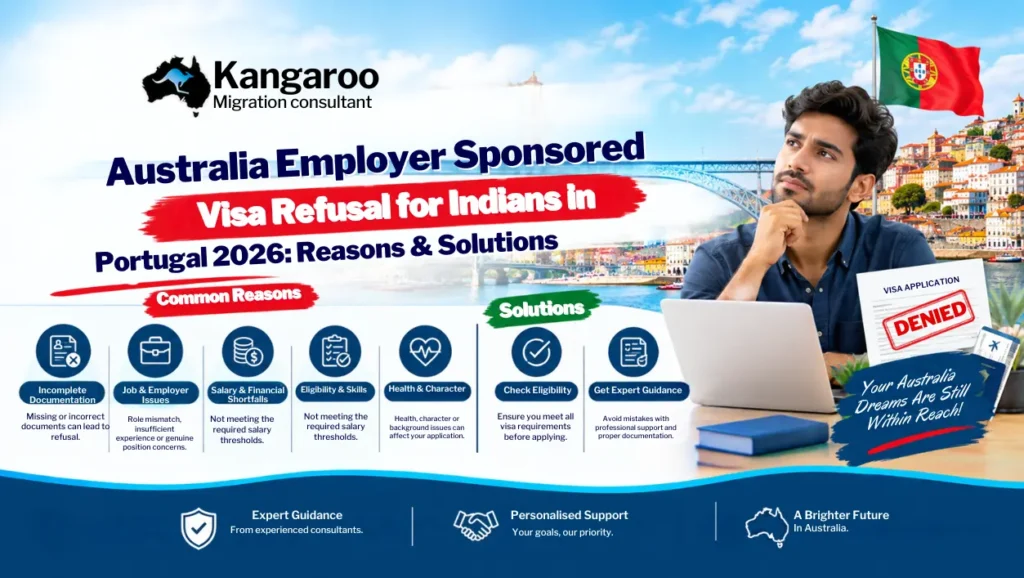
Receiving an Australia employer sponsored visa refusal is unsettling, but it doesn’t necessarily mean every future Australian pathway is closed to you. Refusals can arise from issues on the applicant’s side, the employer’s side, or somewhere in the paperwork connecting the two occupation mismatches, insufficient work experience, salary shortfalls, genuine position concerns, health, character, English, or documentation gaps can all be the underlying cause.
The specific reason stated in your Department of Home Affairs decision letter is the single most important starting point for working out what comes next. If you’re an Indian citizen living in Portugal, it’s also worth separating two facts that often get blurred together: your nationality and your country of residence are different things, and Portuguese residence status doesn’t, by itself, create or remove eligibility for an Australian employer-sponsored visa. This article covers the three main employer-sponsored pathways subclass 482, subclass 186 and subclass 494 and what typically goes wrong with each, alongside our Australia employer sponsored visa for Indians in Portugal if you’re assessing your options from scratch.
If you’ve received a refusal or are concerned that your application may have weaknesses, Kangaroo Migration Consultants can help you review your circumstances, understand the potential issues and assess the appropriate Australian employer-sponsored visa pathway before you take your next step.
Employer Sponsored Visa Refusal Understanding What “Refusal” Actually Means
Employer-sponsored visas involve up to three separate stages: the employer’s sponsorship status, the nomination of a specific position and worker, and the applicant’s own visa application and it matters which of these actually failed. A problem at the sponsorship or nomination stage can derail the whole pathway even when the applicant’s own profile is strong, while a genuine job offer and an approved nomination still don’t guarantee visa grant, since the applicant must separately satisfy the visa-specific criteria. This is worth understanding clearly before you start planning a response, because the fix for a nomination problem looks very different from the fix for, say, an English test issue.
Applicant-Side Reasons: Occupation, Experience and Evidence
A large share of refusals trace back to the nominated occupation not genuinely matching the applicant’s actual duties, qualifications and work experience; a job title alone isn’t proof that the role fits the relevant ANZSCO classification, and generic or broad position descriptions are a common weak point. Work experience is another frequent issue: a reference letter on its own is rarely sufficient, and applicants are generally expected to support their employment history with payslips, tax records and bank statements alongside the reference itself.
For an Indian professional who has worked in both India and Portugal, this becomes especially important when dates, duties and job titles need to line up consistently across your CV, your reference letters, your contracts and your visa application, because even small inconsistencies between countries can raise questions. Skills assessment problems, where the assessing authority doesn’t match the nominated occupation or the assessment itself falls short, and registration or licensing gaps in regulated fields like healthcare, engineering or teaching, can also sit behind an applicant-side refusal.
Employer-Side Reasons: Sponsorship, Nomination and Salary
Not every refusal originates with the applicant. An Australian employer needs to meet its own sponsorship obligations, and a nomination can fail on labour market testing, an unclear business need for the role, or a salary offered below the market rate problems that can affect even a strong candidate through no fault of their own. Salary compliance deserves particular attention in 2026: for nominations lodged between 1 July 2026 and 30 June 2027, the Core Skills Income Threshold and the Temporary Skilled Migration Income Threshold both sit at AUD 79,423, while the Specialist Skills Income Threshold is AUD 146,576.
Meeting the relevant threshold isn’t automatically enough on its own, either employers also need to establish the Annual Market Salary Rate, essentially what an equivalent Australian worker would be paid in the same role, and the nominated salary needs to meet or exceed that benchmark where it’s higher than the standard threshold. A genuine position issue where the role, the organisational structure or the business’s actual operations don’t clearly support the need for a skilled worker can sit alongside or independently of any salary problem, and it’s a reason Home Affairs assesses regardless of how compelling the job offer itself looks on paper.
Documentation, Character and Information Integrity
Missing or inconsistent documentation is one of the most preventable causes of refusal. Mismatched employment dates between a CV, a reference letter and payslips, or job duties described differently across different documents, are exactly the kind of discrepancies that invite scrutiny. For Indians living in Portugal, any documents issued locally in Portuguese generally need to be properly translated into English, and character requirements often require police certificates covering every country where you’ve lived for 12 months or more in the past decade since turning 16 which, depending on your history, could mean certificates from India, Portugal, and potentially other countries as well.
It’s worth treating false or misleading information as a separate and more serious category from simple missing paperwork: providing altered, forged or knowingly inaccurate information can lead not just to refusal but to visa cancellation, restrictions on future applications, and broader consequences, so if you discover an error in something you’ve already submitted, the right move is to correct it through the proper channel rather than quietly submitting replacement evidence.
Does Living in Portugal Change Anything?
Not in the way many applicants assume. Portuguese residence, or even Portuguese permanent residency, doesn’t substitute for Australian visa eligibility, and it doesn’t remove requirements like English testing, health checks or character documentation that would otherwise apply. The relevant question for Home Affairs is always whether you meet the specific criteria of the visa subclass you’ve applied for your country of residence is contextual information, not a separate eligibility pathway. If you’re weighing how your circumstances in Portugal interact with Australian Migration requirements more broadly
What to Do After a Refusal
Start by reading the refusal letter carefully. It should identify the visa subclass, the specific refusal ground, and whether the decision can be reviewed by the Administrative Review Tribunal, along with any applicable deadline. Note that review deadlines are strict and vary by decision type, so this isn’t something to leave for later. From there, try to categorise the issue: is it about your eligibility, your evidence, your employer’s sponsorship or nomination, or something more serious like an information integrity concern? A missing-document problem is generally fixable by gathering better evidence; a salary or nomination issue usually needs your employer’s involvement; a skills or occupation mismatch might mean reconsidering the pathway entirely.
It’s also worth thinking ahead if you’re planning to move between visas for instance, from a Subclass 482 towards a 186 since keeping your role, employer and occupation consistent across that transition matters for avoiding a second refusal down the line. A previous refusal generally needs to be declared in future applications, but it doesn’t automatically doom every subsequent attempt; what matters is that the new application genuinely addresses whatever went wrong the first time, which is exactly why reviewing your refusal letter properly matters more than simply reapplying with the same evidence.
FAQs
What are the common reasons for an Australian Employer Sponsored Visa refusal?
Common reasons can include occupation or duties mismatch, insufficient work experience, salary issues, nomination problems, weak documentation, English requirements, health or character concerns, and genuine position concerns. The specific refusal letter should be reviewed to identify the actual ground for refusal.
Can Indians living in Portugal apply for an Australian Employer Sponsored Visa after a refusal?
Yes, a previous refusal does not automatically prevent an Indian citizen living in Portugal from applying for another Australian visa. However, the applicant should understand and address the reasons for the previous refusal before submitting a new application.
Does living in Portugal affect an Australian Employer Sponsored Visa application?
Living in Portugal does not create a separate Australian employer-sponsored visa category. Eligibility is based on the requirements of the relevant visa subclass, while Portuguese residence may be relevant when providing employment, residence, character and other supporting documents.
Can salary or nomination issues cause an Australian Employer Sponsored Visa refusal?
Yes. Employer-side issues such as salary below the applicable threshold, failure to meet the Annual Market Salary Rate, sponsorship problems, labour market testing issues or concerns about the genuine need for the position can affect a nomination and potentially the visa pathway.
What should I do after an Australian Employer Sponsored Visa refusal?
Start by carefully reviewing the Department of Home Affairs refusal letter to identify the specific refusal ground and whether review rights are available. Depending on the issue, you may need stronger evidence, employer action, a corrected nomination, or consideration of a different visa pathway before applying again.
Get Your Refusal Reviewed Before You Reapply
If you’re an Indian citizen living in Portugal and your Australian employer-sponsored visa has been refused, it’s worth having the refusal reasons and your supporting evidence properly reviewed before you submit anything else. Kangaroo Migration Consultants can help you understand exactly what went wrong, assess whether your occupation, employer nomination or documentation needs to be strengthened, and work out what a stronger next application or a different pathway altogether could look like. Contact Kangaroo Migration Consultants today to discuss your options after a visa refusal.