
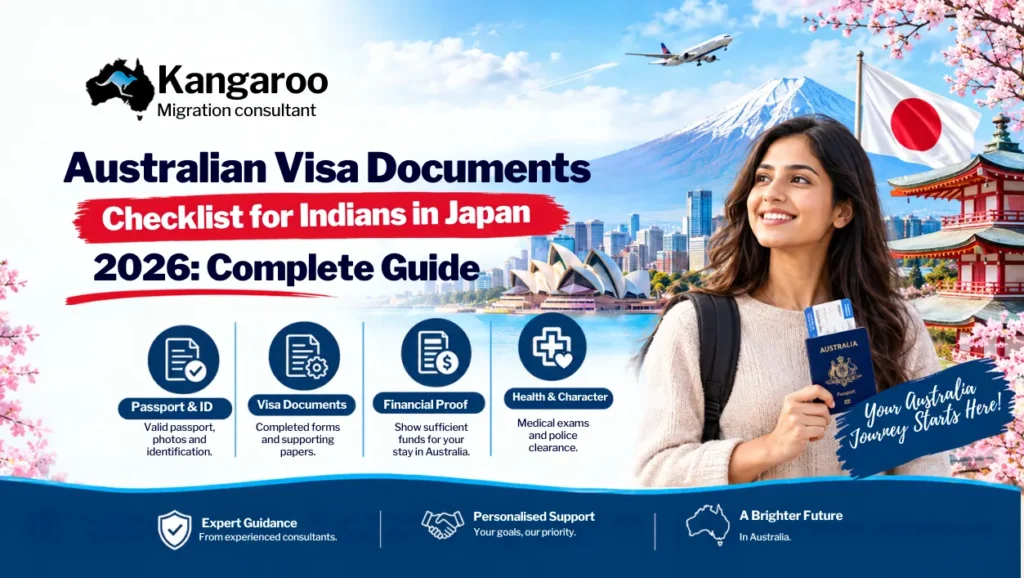
There’s no single Australian visa documents checklist that fits every Indian citizen living in Japan, because what you need to gather depends entirely on which visa you’re applying for. A visitor visa asks for very different evidence than a skilled migration or Subclass 408 application. At Kangaroo Migration Consultants, we’ve noticed that Indians based in Japan often assume their Japanese residence card is the essential document, when in reality it’s supporting evidence of your current circumstances your Indian passport and nationality remain the foundation of every application, and the Department of Home Affairs’ own guidance is explicit that documents required depend entirely on the application form’s own instructions.
This guide separates the documents that matter for most applicants from Japan: identity, residence, employment, financial and translation evidence from the visa-specific paperwork that changes depending on your pathway; if you’re still deciding which visa fits your goals in the first place, on how Indians can move to Australia from Japan covers that question separately.
The Core Document Categories Every Applicant Should Know
Before diving into visa-specific requirements, it helps to think in terms of categories rather than a single flat list: identity documents, Japan residence evidence, employment and financial records, education and qualification documents, English-language evidence, police certificates, health documentation, travel history, and where relevant relationship or family documents and translations. Some of these are mandatory for virtually every application (a valid passport, for instance), while others are visa-specific or only relevant depending on your personal circumstances, so treating every category as equally essential for every visa is a common and avoidable mistake.
Identity and Japan Residence Documents
Your identity file should include your valid Indian passport, the biodata page clearly scanned, any previous passports, and documentation of any name changes through marriage or otherwise consistency across every document matters more than most applicants expect, since a mismatched name or date of birth between your passport and a supporting document is a common cause of delay.
Alongside this, prepare your Japanese Residence Card (front and back), evidence of your current status of residence, and your current Japanese address not because Japanese residence changes your Indian nationality in any way, but because it demonstrates your lawful current circumstances, your employment or study situation, and where the application is genuinely being lodged from. A residence card that’s expired or close to expiring, or a Certificate of Residence that doesn’t match your other paperwork, is worth resolving before you start uploading anything.
Documents by Visa Type: Visitor, Student and Skilled Pathways
A visitor visa application typically draws on your passport, Japan residence card, travel itinerary, accommodation details, employment evidence and financial records showing you can fund the trip and have reason to return, plus an invitation letter where you’re visiting family or friends there’s no single fixed bank-balance figure that applies universally, so the evidence needs to build a believable overall picture rather than hit one specific number.
A student visa instead centres on your Confirmation of Enrolment, academic records, financial capacity evidence, Overseas Student Health Cover, and where relevant English test results, alongside the same passport and Japan residence documentation. For skilled visa requirements, the file grows considerably: skills assessment outcome, academic transcripts, English test results, detailed employment reference letters, and importantly payslips, tax records and bank statements that corroborate your employment history, since a reference letter alone often isn’t considered sufficient evidence of genuine work experience on its own.
Documents for Subclass 408, 407 and Employer-Sponsored Visas
If your purpose is an approved temporary activity rather than migration, Subclass 408 requirements call for evidence of the proposed activity itself, an invitation or engagement letter, event or programme details, and sponsor or support documentation specific to your stream layered on top of your standard identity and Japan residence evidence. The Subclass 407 training visa instead needs a structured training plan and sponsorship documentation showing the training is genuinely occupational rather than general employment. Employer-sponsored routes such as Subclass 482 add an employment contract, nomination and sponsorship evidence from the employer side, alongside your own qualifications, English results and employment history and exactly which documents matter shifts by stream, so don’t assume one employer-sponsored checklist covers every scenario.
Police Certificates, Health Checks and Translations
For most visa categories, applicants and any family members aged over 16 generally need police certificates covering every country where they’ve lived for 12 months or more in the past 10 years since turning 16 which for many Japan-based Indian applicants means certificates from both India and Japan, not just one or the other. Health examinations follow a similar country-agnostic logic: results are generally valid for 12 months, and using an approved panel physician is essential rather than optional.
Any document not already in English a Japanese employment certificate, a Certificate of Residence, or an Indian document in a regional language needs an accompanying English translation, and where that translation is done outside Australia, it should include the translator’s full name, address, phone number and qualifications; keep the original document as well as the translation, since both are typically expected together.
Financial and Employment Evidence Worth Getting Right
Bank statements, salary credits and payslips should tell a consistent story, the account holder’s name should match your passport exactly, and any large or unexplained deposit is worth being ready to explain rather than leaving unaddressed. Employees should gather an employment contract, employer reference letter, tax documents and leave-approval evidence where relevant; self-employed applicants instead need business registration, tax records and business bank statements; and students should have enrolment confirmation and academic records ready alongside the same core identity documents.
Whatever your situation, uploading documents to the correct category in ImmiAccount matters as much as having the right documents in the first place. Supporting documents aren’t accessible for re-download once submitted, so keep your own complete copies of everything you upload.
A Quick Comparison: Applying from Japan vs Applying from India
The core difference between an Indian applicant based in Japan and one applying directly from India isn’t the visa itself, it’s that the Japan-based applicant needs to layer Japanese residence, employment and address evidence on top of the same Indian documents, and may need police certificates from both countries rather than just one. Travel and residential history becomes particularly important here too, since an unexplained gap in your address history between India and Japan tends to draw more scrutiny than a straightforward, continuous record. None of this changes your underlying eligibility for Australia PR pathways or any other route; it simply changes which supporting evidence needs to exist and be gathered before you start the application itself.
FAQs
What documents do Indians living in Japan need to apply for an Australian visa?
Indian applicants living in Japan generally need a valid Indian passport, Japanese Residence Card, proof of address and relevant employment, financial, education and travel documents. Additional documents depend on the specific visa, such as a skills assessment for skilled visas or a Confirmation of Enrolment for a student visa.
Do Indians in Japan need police certificates from both India and Japan?
Depending on their residential history and the visa requirements, applicants may need police certificates from both India and Japan. Applicants should check the Department of Home Affairs requirements for their individual circumstances and disclose their complete residential history accurately.
Do Japanese documents need to be translated into English for an Australian visa application?
Yes. Documents that are not in English generally need to be accompanied by an English translation that meets the Department of Home Affairs’ requirements. Applicants should retain both the original Japanese document and its English translation for submission.
Is a Japanese Residence Card required for Indians applying for an Australian visa?
A Japanese Residence Card can be important evidence for an Indian citizen applying from Japan because it demonstrates their lawful residence and current circumstances in Japan. However, the exact documents required depend on the visa subclass and the applicant’s individual situation.
What documents are required for an Australian skilled visa from Japan?
Applicants for skilled visas may need a positive skills assessment, English-language test results, educational qualifications, detailed employment references, payslips, tax records, bank statements and other evidence supporting their claimed work experience. They may also need their Indian passport, Japanese residence documents, police certificates and health examination results.
Final Thoughts and Your Next Step
Getting your document file right, consistent identity information, complete Japan and India evidence, correct translations, and visa-specific paperwork matched to your actual pathway makes the difference between a smooth assessment and repeated requests for further information. Planning to apply for an Australian visa from Japan as an Indian citizen? Kangaroo Migration Consultants can review your documents before you lodge, help you separate what’s mandatory from what’s merely supporting evidence, and make sure nothing critical is missing. Get in touch today for personalised guidance on your specific visa pathway.