
The hardest conversations in our office are not with weak profiles. They’re with strong ones — engineers with eight years of experience, nurses with spotless records — whose files failed for reasons that were entirely preventable. A reference letter missing duties. Five claimed points that evidence couldn’t support. An EOI lodged under the wrong ANZSCO code.
Australia’s system is transparent, which cuts both ways: it tells you exactly how to win, and it shows no mercy when the file contradicts itself. Here are the real australia pr rejection reasons in 2026 — stage by stage — and how to build a file that survives scrutiny.
What Are the Main Australia PR Rejection Reasons?
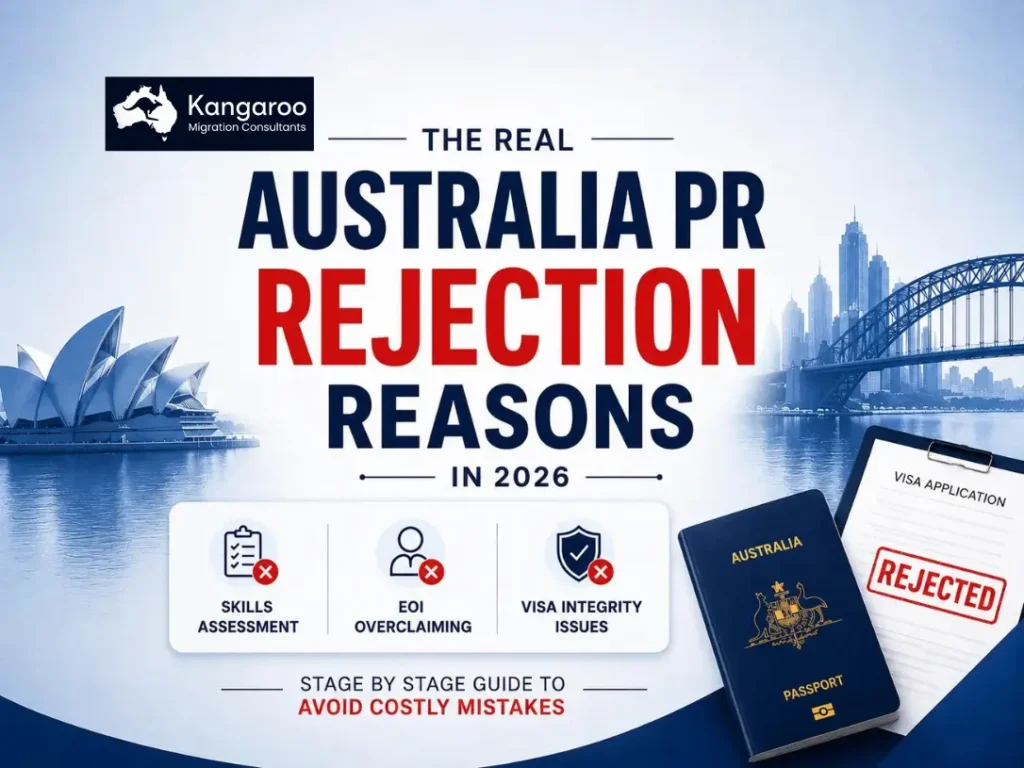
The biggest australia pr rejection reasons cluster at three stages: negative skills assessments (wrong occupation match, undocumented experience), EOI overclaiming (points the evidence can’t prove — which turns into a visa refusal after invitation), and visa-stage integrity issues (inconsistent employment dates, unverifiable references, incomplete family declarations). Almost all are self-inflicted and almost all are preventable with a pre-lodgement audit — which is exactly what Kangaroo Migration Consultants runs before any file we touch goes in.
Stage 1: where skills assessments die
- Wrong occupation choice. Your duties matched a different ANZSCO code than the one you applied under. The assessor doesn’t redirect you — they refuse you.
- Reference letters that name titles, not duties. Assessing authorities want role responsibilities in detail, on letterhead, with dates and hours. “He worked as a Senior Engineer” proves nothing.
- Qualification–occupation mismatch. VETASSESS in particular checks whether your degree field matches your nominated occupation; a BCom applying as a Marketing Specialist needs the employment story to carry the file.
- ACS date maths. IT applicants forget ACS deducts 2–4 initial years as the “skill level requirement met” date — then overclaim experience points downstream.
- Read our complete Skills Assessment for Australia PR guide to understand authority-specific requirements before applying.
Stage 2: the EOI trap nobody warns you about
An EOI is a claim, not a checked document. SkillSelect happily accepts an inflated score — and invites you on it. The refusal comes later, at the visa stage, when a case officer finds the evidence supports 75 points, not the 85 you claimed. You don’t just lose the application — you lose the visa fee, the invitation and potentially face a three-year integrity shadow. The discipline is brutal but simple: claim only what a stranger could verify from your documents alone.
The classic overclaims:
- Experience points counted from graduation instead of the assessor’s skilled date
- Partner points without a completed partner skills assessment
- “Proficient” English claimed on an expired test report
- Australian study points for courses that don’t meet the two-academic-years rule
If you’re lodging your profile for the first time, our EOI for Australia PR guide explains how to claim points correctly.
Stage 3: visa-stage integrity checks
Case officers cross-reference everything: employment dates against PF/tax records, references against LinkedIn, travel history against declared residence. The killers here are inconsistency (dates that disagree across documents), non-disclosure (a refused US visa you “forgot”), and unverifiable employers who don’t answer verification calls. One PIC 4020 finding — false or misleading information — can bar you for three years.
The pre-lodgement audit that prevents all of this
| Check | Question it answers |
|---|---|
| Occupation audit | Do my documented duties match my ANZSCO code — in the assessor’s language? |
| Evidence audit | Can every single claimed point be proven by a document I already hold? |
| Consistency audit | Do dates, titles and salaries agree across references, payslips, tax records and my CV? |
| Disclosure audit | Are all refusals, name variations and family members declared — everywhere, identically? |
Run honestly, this audit takes a weekend and catches the mistake that would otherwise cost eighteen months.
Already refused? Your realistic options
- Negative skills assessment: usually re-appliable with corrected occupation or better evidence — often the cheapest fix in the system.
- Visa refusal after invitation: depending on grounds, options range from review (onshore) to a rebuilt, corrected application — but PIC 4020 findings need specialist handling.
- Whatever you do, don’t rush a duplicate file. A second application repeating the first one’s flaw converts a mistake into a pattern.
FAQs
What is the most common Australia PR rejection reason?
At the assessment stage, occupation–duties mismatch; at the visa stage, points overclaiming discovered when evidence is checked. Both are preventable with a pre-lodgement audit.
Does a skills assessment rejection affect future applications?
A negative assessment isn’t a visa refusal and doesn’t create a formal bar — you can reapply with the correct occupation or stronger evidence.
What is PIC 4020?
An integrity provision allowing refusal for false or misleading information — with a potential three-year bar. It’s why “minor” embellishments are never minor.
Can I fix an EOI after submission?
Yes — update it any time before invitation. After invitation, your claims freeze; that’s why the audit must happen before, not after.
What are the most common Australia PR rejection reasons?
The most common Australia PR rejection reasons include claiming incorrect points, choosing the wrong ANZSCO occupation, negative skills assessments, inconsistent documents, and providing incomplete or misleading information during the visa process.
Can I apply again after an Australia PR rejection?
Yes, you can usually apply again after an Australia PR rejection, depending on the reason for refusal. Correcting documentation errors, improving eligibility, or obtaining a positive skills assessment can significantly improve your chances.
How can I avoid Australia PR rejection?
To avoid Australia PR rejection, ensure your claimed points are supported by evidence, select the correct occupation, submit accurate reference letters, disclose all required information, and verify every document before lodging your application.
Does Australia PR rejection affect future visa applications?
An Australia PR rejection does not automatically prevent future applications. However, if the refusal involves false or misleading information (such as under PIC 4020), it may result in penalties or a temporary ban on applying for certain Australian visas.
Conclusion
The most important lesson from these Australia PR rejection reasons is simple: a strong profile is not enough. Your application must also be accurate, consistent and fully supported by evidence at every stage.
The correct occupation, a defensible points score and matching information across your EOI, skills assessment, employment records and visa application can make the difference between an invitation and a refusal. Before lodging, review every date, duty, document and declaration as if a case officer were checking it for the first time.
At Kangaroo Migration Consultants, we assess the risks before submission—not after a refusal. Our pre-lodgement audit helps identify occupation mismatches, unsupported points, documentation gaps and inconsistencies before they become expensive problems.
A careful application may take slightly longer to prepare, but it is far better than losing months, fees and an invitation because of one preventable mistake.