
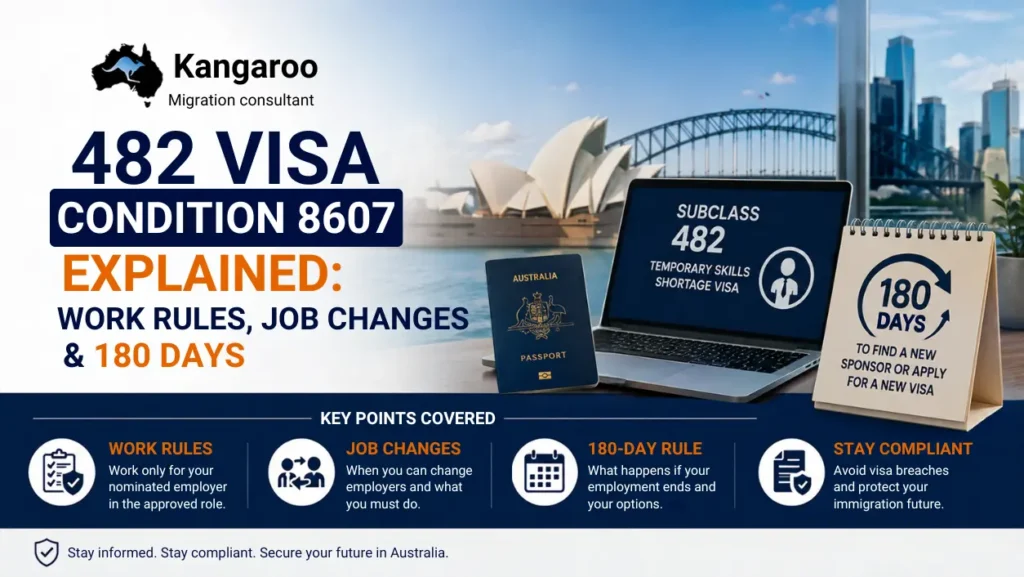
“I’m on a 482 visa and want to leave my employer. How long do I have to find another job, and what does 482 Visa Condition 8607 actually allow?” This is one of the most common questions Subclass 482 holders ask, and it’s rarely answered correctly on first read. Condition 8607 controls what work you can do, who you can work for, what happens when employment ends, and what steps are genuinely required to change employer or occupation.
At Kangaroo Migration Consultants, we want to be direct about one thing immediately: the 180-day period is not general permission to work anywhere for six months, it’s a limited window governed by specific rules, and misunderstanding it is one of the more common ways 482 holders accidentally put their visa at risk.
What Is 482 Visa Condition 8607?
Condition 8607 rests on three central components: you must work only in your nominated occupation, you must generally work only for your sponsoring business (or an associated entity, unless an exemption applies), and specific time limits apply once that employment stops. It applies to both the older Temporary Skill Shortage visa and the current Skills in Demand visa subclass 482, and the exact rules can vary slightly depending on your specific stream which is exactly why understanding your own Subclass 482 Core Skills sponsorship structure before assuming a general rule applies to you matters so much here.
You Must Work in Your Nominated Occupation
The rule requires you to work only in the occupation identified in your most recently granted 482 nominations, not simply a role with a similar-sounding title. If your visa was granted for the occupation of Software Engineer, moving into a role that’s mostly help-desk, sales, or project coordination could put you outside your nominated occupation even if your employer calls it a “promotion.” A person nominated in an IT occupation cannot simply move into an unrelated role because another employer offers a higher salary. The occupation match, not the job title, is what Condition 8607 actually cares about, a distinction that carries real weight when weighing your broader Australia PR pathways down the line.
Changing Occupation Requires a New Nomination and New Visa
Changing employers and changing occupations are genuinely different things, and conflating them is where many visa holders run into trouble. Moving to a new sponsor may be possible if the correct nomination process is completed but if your new role sits in a different occupation, you generally need a fresh nomination and a new 482 visa grant before starting that role. A promotion that shifts you from a hands-on technical position into management, for instance, doesn’t automatically stay within the same nominated occupation just because your employer frames it positively, checking the actual duties against your approved occupation before accepting any new title matters more than the title itself.
You Must Usually Work for Your Sponsor or an Associated Entity
Condition 8607 generally requires you to work only for the entity that nominated you, or an associated entity, unless a specific exemption applies. This matters considerably for casual side jobs, freelance projects, weekend shifts, or a second employer opportunity. A 482 visa is not an open work visa, and even work within your own nominated occupation can create a problem if it’s performed for the wrong employer. Whether an exemption applies depends on your specific circumstances, so treating any extra income as automatically safe is a genuine risk worth avoiding, similar to the caution we’d apply when reviewing Australia migration requirements more broadly before assuming a shortcut exists.
The 180-Day Rule, Explained Properly
Since 1 July 2024, Condition 8607 gives sponsored workers considerably more flexibility when their sponsored employment ends. This deserves real depth rather than a quick summary, because the details genuinely change how you should plan: the amendment allows an affected 482 holder to stop working in accordance with their sponsorship conditions, or to work outside those conditions, for up to 180 consecutive days at one time, with the explicit purpose of giving them time to find a new sponsor, apply for another visa, or depart Australia a meaningful improvement over the far tighter 60-day window that applied previously.
But this flexibility comes with real limits attached, and it’s worth understanding both of them together rather than in isolation: the 180-day figure describes the maximum length of a single period without approved work, while a separate, cumulative 365-day total limit applies across your entire visa period meaning if you experience one employment gap of 120 days and later a second gap of 100 days, your running total sits at 220 days, still under both limits individually but genuinely counting toward the same overall cap, and multiple gaps across a multi-year visa can accumulate toward that 365-day ceiling even though no single gap ever approached 180 days on its own.
The clock does not simply “reset” the moment you find a new sponsor every day outside approved, sponsored employment counts toward the lifetime 365-day total for that visa, which is precisely why tracking dates carefully from the moment employment ends, rather than estimating loosely, is one of the single most protective habits a 482 holder can build.
The 180 Days Does Not Mean Open Work Rights
This flexibility exists to give you breathing room to arrange your next lawful step; it does not convert your 482 into a general work visa for six months. Even though 180 days sounds generous, employer sponsorship paperwork, labour market considerations, nomination preparation, and occupation matching can all take genuine time, so the safest approach is starting your search and documentation immediately after employment ends rather than treating the window as slack to use up.
Documenting Your Employment End Date
Your employment end date is the anchor point for both the 180-day and 365-day calculations, so it needs to be clear and properly documented termination letters, resignation acknowledgment, or other written evidence, not just a verbal conversation you might struggle to prove later if your timeline is ever questioned. If a change is planned rather than sudden, you’re actively considering resigning for a better opportunity reviewing your migration position before you leave your current job, rather than after, giving you considerably more control over the transition.
Side Jobs and Second Employment Carry Genuine Risk
Rideshare driving, freelance projects, casual weekend shifts, or a second employer all of these should be treated carefully rather than assumed safe. Whether they’re permitted depends on your specific visa conditions, the role, the employer, and whether an exemption genuinely applies, and unpaid or casual work is not automatically exempt just because no salary changes hands. This is exactly the kind of assumption that turns a well-intentioned side gig into an accidental condition breach.
What Counts as a Breach, and What It Can Affect
Working for an unauthorised employer, working outside your nominated occupation, or exceeding the applicable time limits can all constitute a breach of Condition 8607 and breaches carry real consequences, potentially affecting your current visa and future visa applications alike, which is why compliance issues discovered late should prompt professional advice rather than guesswork. This matters for more than your current visa status too: many 482 holders use their sponsored employment as a stepping stone toward a longer-term strategy, whether through the Subclass 491 regional pathway, employer-sponsored PR, or state nomination, and work gaps, role changes, or occupation changes made without checking the rules can quietly undermine that future strategy just as much as they threaten your current visa.
Sponsors Share the Compliance Responsibility
Condition 8607 isn’t a one-sided obligation; sponsors have their own responsibilities to ensure the worker remains in the approved role, that salary and conditions stay consistent with what was approved, and that relevant changes are properly reported. A well-managed sponsorship relationship, with clear written communication on both sides, reduces risk considerably more than either party assuming the other has it covered.
Common Mistakes to Avoid
Frequent, avoidable errors include assuming the 180-day period means unrestricted work rights, starting a new job before the correct nomination process is actually in place, changing occupation without securing a new visa first, forgetting that the 365-day cumulative total exists alongside the 180-day single-period limit, treating casual side work as automatically safe, failing to keep written proof of your employment end date, waiting too long after job loss to begin the sponsor search, and overlooking how a work change might affect a future PR strategy such as Australian PR without employer sponsorship if that’s part of your eventual plan.
FAQs
What is Condition 8607 on a 482 visa?
Condition 8607 is a work condition requiring most Subclass 482 visa holders to work only in their nominated occupation and generally only for their sponsoring employer or an associated entity, unless an exemption applies.
Can I change employers on a 482 visa?
Yes, but the new employer generally needs to complete the correct sponsorship and nomination process before you start working under that new arrangement.
What is the 180-day rule for a 482 visa?
Since 1 July 2024, if your sponsored employment ends, you may stop working or work outside your sponsorship conditions for up to 180 consecutive days at one time.
Does the 180-day rule mean I can work anywhere during that time?
No, the 180-day period gives temporary flexibility to find a new sponsor, apply for another visa, or depart Australia; it doesn’t turn your 482 into an open work visa.
Is there a limit beyond the 180-day rule?
Yes, there’s also a 365-day cumulative total limit across your entire visa period, meaning multiple shorter gaps can add up toward this cap even if no single gap reaches 180 days.
Final Thoughts
Condition 8607 requires you to work in your nominated occupation and generally only for your sponsor or an associated entity, with up to 180 consecutive days and 365 total days of flexibility if sponsored employment ends but this flexibility is a bridge to your next lawful step, not an extended vacation from visa compliance. Changing employers is possible with the right nomination process in place; changing occupation requires a new nomination and new visa grant before you start. Keep dates documented, act early, and don’t assume a promotion, side job, or new sponsor arrangement is automatically fine just because it sounds reasonable.
Changing employers while holding a 482 visa? Before you resign, start a new job, or approach another sponsor, Kangaroo Migration Consultants can review your visa conditions and proposed employment arrangements so you understand your options and avoid an accidental breach contact our team today.